Cardboard in Exhibitions – Lightweight, Strong, Recyclable Structures
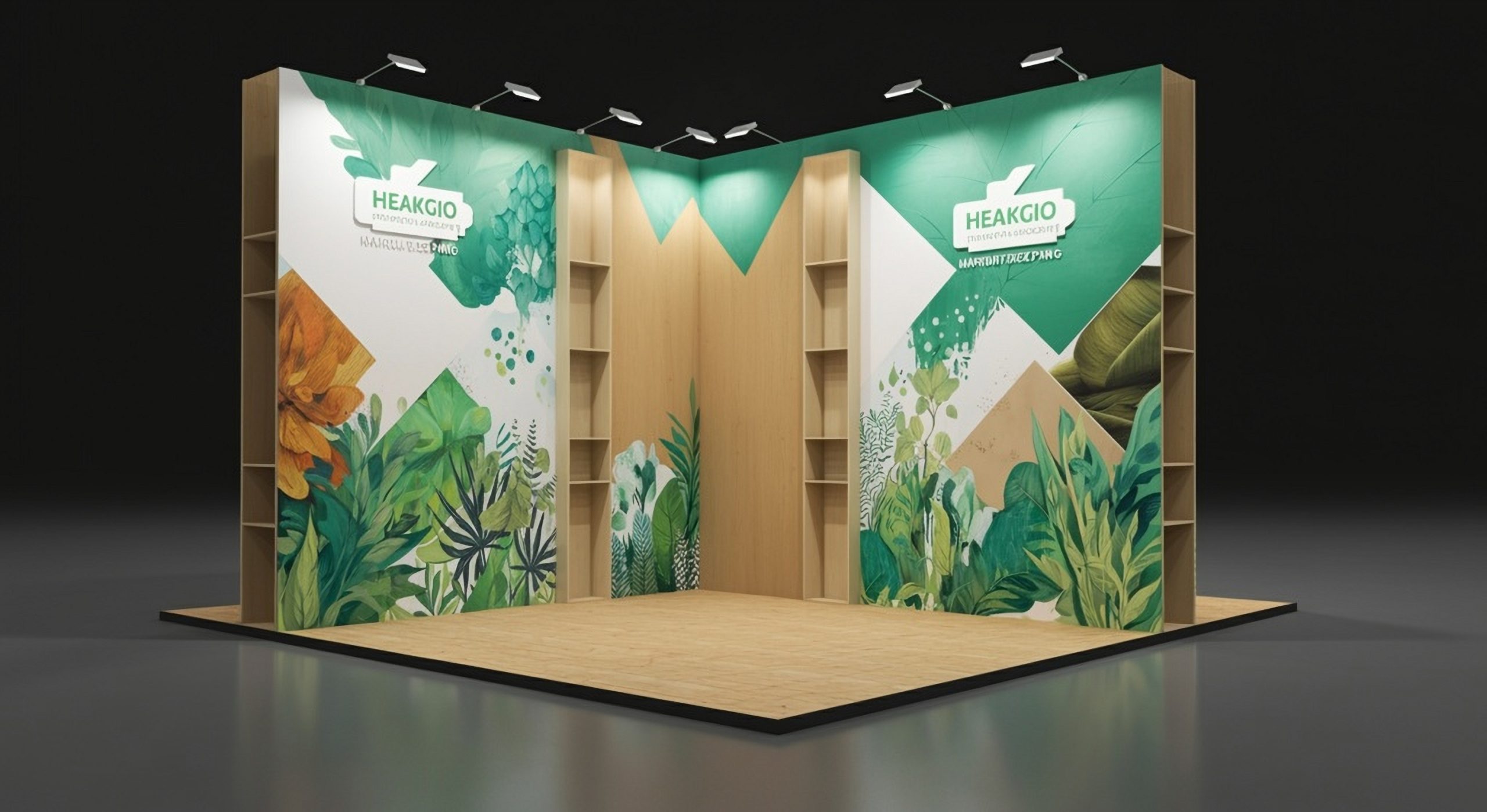
Cardboard exhibition stands work when the board itself is engineered to carry load, survive handling, and move efficiently through the exhibition supply chain.
This isn’t about novelty displays or short-term visuals.
It’s about structural performance, manufacturability, logistics efficiency, and recyclability at scale.
For commercial exhibitions, cardboard only succeeds when it’s designed and produced like an engineered material, not a decorative one.
Why cardboard works in exhibition environments
Strength-to-weight ratio is the starting point
Modern cardboard exhibition stands rely on corrugated and honeycomb board structures engineered for compression, rigidity, and dimensional stability.
Compared with MDF or composite panels:
- Cardboard delivers a far higher weight-to-strength ratio
- Load-bearing capacity can be engineered through flute profiles, liners, and core density
- Structural rigidity comes from geometry, not mass
This allows large exhibition stands to remain stable without excessive material input.
Engineering replaces bulk
Cardboard exhibition stands are designed around:
- Compression resistance
- Flexural strength
- Shear performance
- Edge protection
Through CNC cutting, interlocking joints, v-grooving, and cellular geometry, engineers create structures that carry load efficiently rather than resisting it through weight.
Board engineering for exhibition loads
Corrugated and honeycomb board selection
Different exhibition applications demand different board constructions.
Typical options include:
- High-density corrugated cardboard for vertical load-bearing
- Honeycomb boards for large panels and cantilevered surfaces
- Multi-liner kraft constructions for edge durability
Board mills tune flute size, liner weight, and fibre composition to meet specific structural requirements.
This is where Limehouse Board Mills add value, supplying board either to exact client specification or from calibrated stock grades proven in exhibition use.
Compression and stability under real conditions
Exhibition stands face:
- Repeated assembly and disassembly
- Localised point loads
- Transport vibration
- Short-term humidity variation
Engineering focuses on maintaining modulus of elasticity and dimensional stability across these conditions, not just passing lab tests.
Lightweight as a logistics advantage
Logistics engineering, not convenience
In exhibition environments, lightweight cardboard is a supply chain advantage.
Engineered exhibition boards can be:
- Around 75% lighter than MDF equivalents
- Flat-packed without loss of structural integrity
- Packed at far higher density per pallet
This means:
- Up to four times more stand volume per UK pallet
- Fewer vehicle movements
- Lower carbon per kilometre
Lightweight reduces environmental footprint before the stand is even assembled.
Handling and installation efficiency
Lower unit weight reduces:
- Manual handling risk
- Installation time
- On-site labour requirements
For commercial events with tight build windows, this reliability matters.
Manufacturing exhibition-grade cardboard
Board mill production process
Exhibition-grade cardboard starts with controlled fibre sourcing and mill-level process management.
Key factors include:
- Recycled fibre ratios balanced with strength requirements
- Liner consistency for print-ready surfaces
- Moisture control during manufacture
- Tight tolerances for CNC compatibility
Cardboard for exhibition stands must arrive flat, stable, and predictable.
Manufactured in the UK, supplied at speed
UK board mills support:
- Short lead times
- Stock and bespoke board formats
- Consistent repeatability across multiple events
This matters for national exhibition programmes running across multiple venues.
Sustainability through engineering, not claims
Fully recyclable by design
Sustainable cardboard exhibition stands work because:
- Fibre-based materials remain compatible with UK recycling streams
- Structures avoid permanent composite bonding
- Inks, laminates, and surface treatments are specified for recyclability
End-of-life recovery is engineered, not assumed.
Carbon and material efficiency
Sustainability gains come from:
- Reduced raw material input
- Lower transport emissions
- Closed-loop recycling of board
Cardboard exhibition stands perform well because the infrastructure already exists and operates at scale.
Fire performance and compliance considerations
Fire retardancy where required
For venues requiring compliance, fire-retardant (FR) treatments can be applied to exhibition boards.
Engineering focuses on:
- Retardancy treatments that don’t compromise recyclability
- Maintaining structural performance post-treatment
- Avoiding unnecessary over-specification
This keeps material efficient while meeting event requirements.
Why cardboard exhibition stands scale commercially
Cardboard exhibition stands succeed in commercial environments because they are:
- Structurally engineered
- Logistically efficient
- Cost-effective to manufacture
- Fully recyclable at end of life
When supplied from UK board mills with the right engineering input, cardboard becomes a reliable structural material for exhibitions, not a compromise.
Expert customer support
Tell us what you need, and our expert team will work with you to find the perfect solution. If it's made of cardboard then we are the people to speak to!
Tell us what you need, and our expert team will work with you to find the perfect solution. If it’s made of cardboard then we are the people to speak to! Get in touch today to see how we can help.

Bulk Ordering
For businesses large and small.

Eco-Aware Products
Recyclable, compostable, and food-safe.

Built to perform
Packaging that holds up and looks right.